Small-molecule metabolic research · Research file
5-Amino-1MQ
A source-linked five-part research file on NNMT inhibition, primary cell and mouse-model studies, and the limits of the preclinical record.
Five linked editorial lenses · research context only · sources linked below

The primary paper reports work on a family of methylquinolinium NNMT inhibitors and evaluates permeability, selectivity, cell-based assays, and a mouse-model experiment. The paper's findings apply to the tested compounds, preparations, and experimental conditions described there; a compound name alone does not establish the identity or quality of any separate material.
This research file distinguishes the compound class and enzyme target from the questions tested in individual assays. Check each source for exact compound identity, analytical methods, controls, and model before interpreting a claim.
- Research category: small-molecule enzyme-inhibitor research
- Target investigated: nicotinamide N-methyltransferase (NNMT)
- The primary source evaluates a methylquinolinium inhibitor series; consult its methods for compound-level details

The primary paper reports that NNMT-inhibitor treatment in cultured adipocytes reduced measured 1-methylnicotinamide (1-MNA), increased measured NAD+ and SAM, and suppressed lipogenesis under the reported assay conditions. These are assay-specific observations, not proof of a complete pathway or a general biological outcome.
The 2021 review describes NNMT's connections to nicotinamide and SAM metabolism and notes that the exact mechanisms remain incompletely understood. Keep measured metabolites separate from mechanistic interpretation, and avoid assuming every finding applies to every inhibitor in the series.
- NNMT uses nicotinamide and SAM in the reaction summarized by the review
- The primary study measured 1-MNA, NAD+, SAM, and lipogenesis in cell experiments
- A pathway illustration is explanatory, not a confirmed complete mechanism
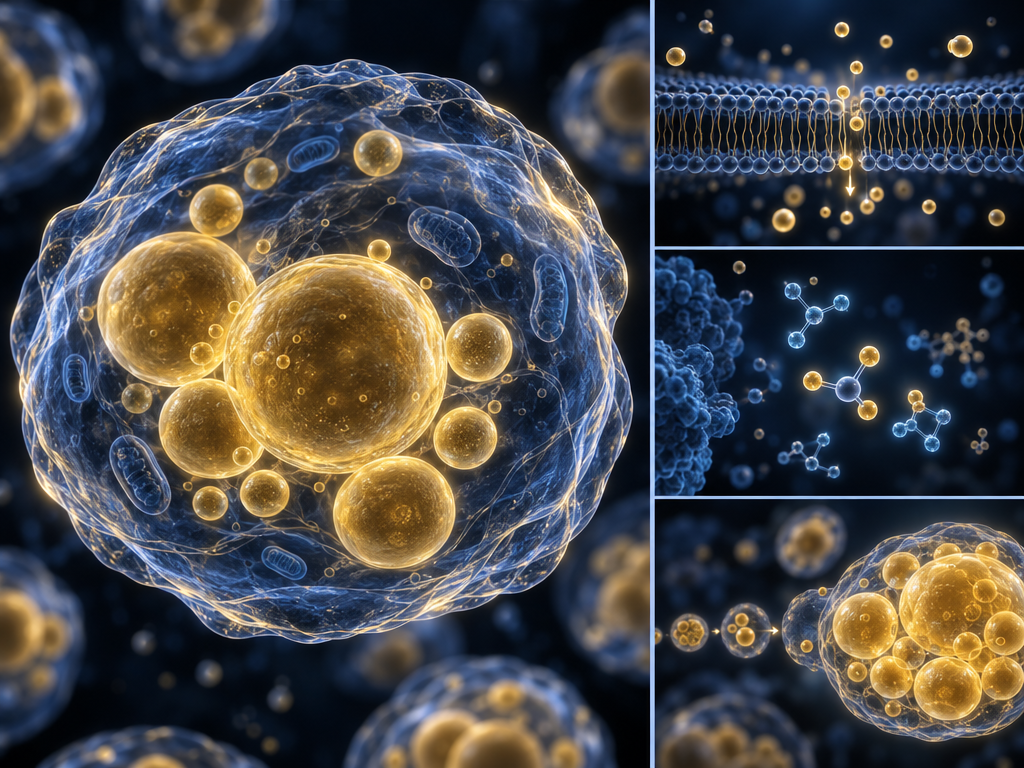
The authors assessed membrane permeability using parallel artificial membrane and Caco-2 cell assays, and examined selectivity against related methyltransferases and enzymes in the NAD+ salvage pathway. Separate cultured-adipocyte experiments measured metabolites and lipogenesis. These assay types address different questions and should not be treated as interchangeable evidence.
The paper also reports testing a potent inhibitor in diet-induced obese mice. Interpret that record by retaining the model, experimental conditions, comparator, measured endpoints, and limitations reported in the original paper. The results are preclinical and do not establish outcomes beyond the studied model.
- Permeability: parallel artificial membrane and Caco-2 cell assays
- Selectivity: related enzymes assessed in defined assays
- Cell record: adipocyte metabolite and lipogenesis measures
- Animal record: diet-induced-obesity mouse model

The primary paper connects enzyme-inhibition and cell-assay questions with a separate in-vivo proof-of-concept experiment. The designs differ in model, exposure context, measurement, and interpretation. Summarizing them side by side can clarify the research program, but it is not a direct comparison of model performance or evidence of translation.
The review discusses broader NNMT research, including knockdown and other inhibitor work. Those findings provide context for the target, but should not be attributed automatically to 5-Amino-1MQ or conflated with the primary study's compound-specific experiments.
- Separate compound-specific inhibitor experiments from broader NNMT research
- Keep cultured-cell and animal-model records distinct
- Cross-study context does not establish translation, equivalence, or a shared measured endpoint

The primary paper reports permeability, selectivity, cell-based, and mouse-model experiments. The 2021 review states that clinical trials targeting NNMT had not been reported at that time and emphasizes that mechanisms were not fully understood. That dated review statement should be read in context; it is not a live trial-registry search.
The key limits are the scope and replication of the cited preclinical work, compound-specific characterization, assay design, and the separation between target-level observations and broader interpretations. Consult the original methods and later literature before drawing conclusions; unresolved questions should remain unresolved rather than being filled with claims from adjacent NNMT research.
- The cited primary record is preclinical
- Do not attribute all NNMT-target research findings specifically to this compound
- The 2021 review describes unresolved mechanistic questions and no NNMT-targeting clinical trials reported at that time
- Study model, assay, replication, and compound characterization bound interpretation
Reading the source record
Follow each link to the original methods, endpoints, and limitations. This editorial summary is not a substitute for the source paper; interpretations should remain within the tested design and evidence scope.