Cellular cofactor research · Research file
NAD+
A source-linked research file tracing NAD+ identity, redox and enzyme roles, measurement questions, comparative interpretation, and evidence boundaries.
Five linked editorial lenses · conceptual artwork · primary sources linked below
01 · Identity & biochemical context
Meet the Molecule
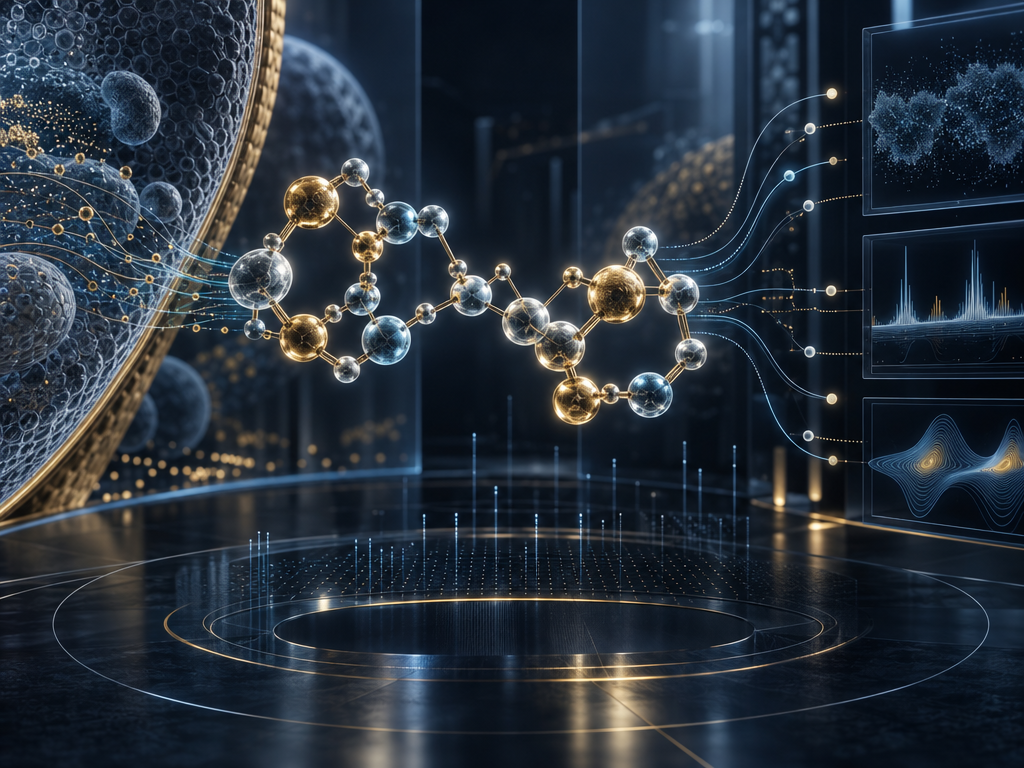
Nicotinamide adenine dinucleotide (NAD+) is a cellular coenzyme—not a peptide—with research roles in redox metabolism and enzyme activity.
NAD+ is commonly considered alongside NADH as a redox pair. Enzymes transfer electrons between these forms in metabolic reactions, while NAD+ is also consumed as a substrate by several enzyme families. These roles are related but not interchangeable.
A careful research record identifies the molecule, pool, reaction, assay, and measured endpoint. A general statement about cellular NAD+ biology should not be mistaken for a result about every tissue, compartment, or experimental preparation.
- Molecule class: pyridine nucleotide coenzyme
- Redox pair: NAD+ / NADH
- Cofactor activity and enzyme-substrate roles are distinct
02 · Redox, substrate, and signaling roles
Peptide Signal

NAD+ research covers electron-transfer metabolism and enzyme systems that consume NAD+ as part of their activity.
Reviews describe NAD+ as a substrate for sirtuins and poly(ADP-ribose) polymerases (PARPs), and as a molecule consumed by enzymes including CD38. These families are studied in different biochemical contexts; naming them does not establish that a single experiment measured every pathway or that a proposed chain is complete.
For each mechanistic statement, inspect the model, intervention, direct assay, and endpoint. Separate an observed change in a measured NAD pool from interpretation about enzyme activity, signaling, or downstream cellular function. This illustration is an editorial guide, not experimental data or proof of a causal sequence.
- Sirtuins: NAD+-dependent enzyme family
- PARPs: NAD+-consuming ADP-ribosylation enzymes
- CD38 and other NADases: distinct routes of NAD+ consumption
03 · Study & analytical record
The Kinetic Surface Mesh

Studies can ask different questions about synthesis, consumption, compartmentation, and downstream readouts; assess each record on its own methods.
The literature includes biochemical and cell-model work, organism-level studies, and broad reviews. A review can map a field, but it does not substitute for the methods of a primary experiment. Check the experimental system, how NAD+ was quantified, which compartment or sample was analyzed, the comparator, and the endpoint.
Measurement is central to interpretation. A whole-cell or whole-sample value may not describe local availability in the nucleus, cytosol, or mitochondria. Assay specificity, sample handling, extraction, timing, and normalization can affect what a reported value supports.
- Record the model and sample compartment
- Check assay method, specificity, timing, and normalization
- Keep direct measurements distinct from pathway interpretation
04 · Comparative research
The Cellular Signaling Cascade

Comparisons among NAD+ research strategies are meaningful only when the intervention and measured biochemical question are aligned.
Studies may examine NAD+ directly, investigate precursor pathways, alter biosynthetic enzymes, or study NAD+-consuming enzymes. These are different experimental perturbations; they should not be treated as equivalent simply because each concerns the cellular NAD+ network.
When comparing reports, check the intervention, model, compartment, comparator, measurement method, and endpoint. Results from separate experiments do not establish that distinct approaches act together, share a complete mechanism, or produce equivalent changes in every NAD+ pool.
- Direct NAD+ measurements differ from precursor-pathway readouts
- Biosynthesis and consumption experiments test different nodes
- Cross-study comparison is descriptive unless the design supports a direct contrast
05 · Evidence boundaries
The Quantum Docking
Bottom line: NAD+ has established biochemical roles, while conclusions about its availability depend on the specific model, compartment, intervention, and endpoint.
The source record supports broad roles for NAD+ in redox metabolism and NAD+-dependent enzymatic processes. It does not justify a universal claim that changing one measured pool has the same consequence across tissues, experimental systems, or biological conditions. NAD+ can be both a cofactor and a substrate; that creates context-dependent questions rather than a one-direction summary.
Compartmentation, assay limits, model relevance, and the distinction between mechanism and downstream interpretation are essential boundaries. Follow linked reviews to their cited primary studies, then evaluate the original methods and limitations before drawing broader conclusions. This file is an educational research reference, not a protocol or personal-use guide.
- A whole-sample measurement may not represent every intracellular pool
- Synthesis, salvage, and consumption interventions are not the same experiment
- Keep conclusions within the tested model, method, and endpoint
Source file
- NAD+ metabolism and its roles in cellular processes during ageing · review ↗
- NAD+ metabolism: compartmentation, signaling, and cellular functions · review ↗
- NAD+ as a signaling molecule · review of biosynthesis and consumption ↗
- NAD+ biology in cellular processes during ageing · review ↗
- NAD+ metabolism in cardiac health and disease · Circulation review ↗
Reading the source record
Follow the linked reviews to their cited primary studies and inspect the original methods, sample, assay, endpoints, and limitations. This editorial summary is not a substitute for the source papers; interpretations should remain within the tested design and evidence scope.